


Traditional Barrel Sauna Benefits Guide for Recovery
Last Updated: October 23, 2026
Quick Summary
A barrel sauna is a cylindrical cedar stave sauna whose curved walls keep hot air circulating in a continuous loop, so the interior warms more evenly than a square cabin with cold corners. It suits tight patios and garden settings, though it is harder to insulate in very cold climates. Most sessions run 10 to 20 minutes per round, two to three rounds total.
- A 6,000-watt electric heater in a well-built cedar barrel typically reaches 160-180°F in roughly 20-40 minutes in mild weather.
- A one-hour session on a 6,000-watt heater costs about $0.90-$1.20 at typical residential rates.
- Beginners should start with sessions of around 8 to 10 minutes and build up over several sessions.
- Schedule your session 60 to 90 minutes before bed so your core temperature has time to drop.
- The most important installation decision is drainage and a level base, checked before winter every year.
Table of Contents
- How a Barrel Sauna Works and Why the Shape Matters
- Barrel Sauna vs Traditional Sauna: Which Design Fits Your Routine
- What the Research Says About Sauna Health Benefits
- Heat-Up Time, Heat Retention, and Real Operating Costs
- Barrel Sauna Disadvantages You Should Weigh First
- How Long to Stay in a Sauna and How to Build a Safe Session
- Barrel Sauna Maintenance, Installation, and Site Planning
- Frequently Asked Questions
How a Barrel Sauna Works and Why the Shape Matters
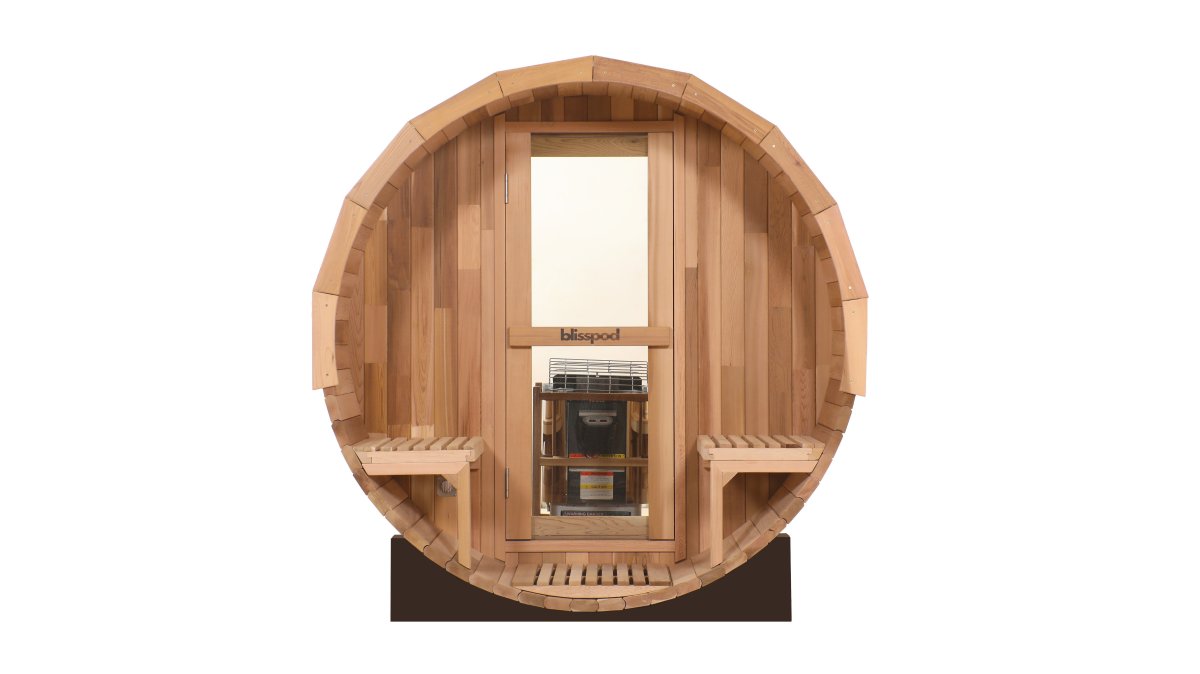
A traditional barrel sauna is a cylindrical outdoor sauna built from staves of wood, usually cedar, that curve into a barrel shape around a central heater. The shape is not decoration. Curved walls let hot air circulate in a continuous loop instead of stalling in corners, so the whole interior warms more evenly.

Heat rises along the curve, cools slightly against the walls, and drops back toward the heater. That loop is the entire design argument.
Curved Walls, Airflow, and Heat Circulation
Square saunas have four corners where air sits still. Those corners stay cooler while the center of the room gets hot, which is why some bathers shift seats mid-session. A barrel's curved walls eliminate that dead space. The result is a more consistent temperature from bench to bench and, in most setups, a faster warm-up because there is less volume to heat unevenly.
Ventilation still matters. Most barrels use adjustable vents near the floor and ceiling to control the exchange of fresh and hot air.
Barrel Sauna vs Traditional Sauna: Which Design Fits Your Routine
The barrel sauna vs traditional sauna decision comes down to footprint, aesthetics, and how you plan to use the space. A barrel sauna wins on compact design: the cylinder packs seating into a smaller footprint than a square cabin of similar capacity.

Here is how we would frame the trade-off:
| Factor | Barrel Sauna | Square/Traditional Sauna |
|---|---|---|
| Footprint | Compact cylinder, fits tight patios | Larger rectangular base |
| Heat circulation | Curved walls, fewer cold corners | Corner dead zones possible |
| Interior layout | Curved benches, less shelving | Flat walls, flexible benches |
| Aesthetic | Rustic, blends into garden | Cabin-like, architectural |
| Installation | Prefabricated kit, relocatable | Often built-in, harder to move |
For a backyard sauna where space is tight and you want something that looks at home in a garden, the barrel shape is the practical pick.
What the Research Says About Sauna Health Benefits
Sauna health benefits are real but often oversold. The strongest evidence links regular sauna use to improved cardiovascular function and relaxation, while claims about detoxification and skin health are far weaker.
Most published sauna research comes from Finland and involves traditional hot-air saunas, not infrared cabins or barrel builds specifically. The National Center for Complementary and Integrative Health is a reasonable starting point for understanding what the evidence does and does not support.
Cardiovascular Function, Circulation, and Heart Health
Heat exposure raises your heart rate and dilates blood vessels, which is why a sauna session can feel like light exercise. Observational studies associate frequent sauna use with better heart health outcomes, though these are associations, not proof of cause (pubmed.ncbi.nlm.nih.gov). If you have a heart condition, talk to your doctor before making sauna use a habit. That is not a disclaimer we add lightly; heat stress is a genuine cardiovascular event.
Muscle Recovery, Stress Relief, and Sleep
For athletes and anyone with a physically demanding job, the recovery case is intuitive. Heat increases circulation to muscles, which many people find eases soreness after a workout. The relaxation effect is the more reliable benefit: a quiet, warm room with nothing to do is a rare thing, and many customers describe their session as the only part of the day their mind actually slows down.
Heat-Up Time, Heat Retention, and Real Operating Costs
Most barrel sauna guides stop at "it heats up fast." That is not useful when you are deciding between a 4-person and a 6-person barrel, or between electric and wood-burning. Here is the practical breakdown, with the variables that actually move the numbers.

Warm-Up Time by Heater Type and Conditions
Warm-up time is a function of heater wattage, interior volume, outdoor temperature, and how well the barrel is insulated. A few grounded rules of thumb:
- A 6,000-watt electric heater in a well-built cedar barrel typically reaches a usable 160-180°F in roughly 20-40 minutes in mild weather (above 40°F).
- The same heater in a 6-person barrel takes longer than in a 4-person barrel because there is more air volume to heat.
- Below freezing, expect warm-up to stretch by 30-50% unless the barrel is well insulated or the heater is oversized for the volume.
A common pattern among owners is to preheat 30 minutes before a session in summer and 45-60 minutes in winter. If you plan to use the sauna daily in a cold climate, sizing the heater slightly above the manufacturer's minimum recommendation is the single most effective way to cut warm-up time.
Heat Retention and Why Wood Choice Matters
Cedar and ThermoWood both insulate well because the wood cells trap air. A barrel's compact cylindrical volume means less air to keep hot than a square cabin of similar seating capacity, which is part of why barrels hold temperature efficiently once warm. The trade-off is that the curved lower staves are more exposed to weather and, in very cold climates, a barrel is harder to insulate as thoroughly as a purpose-built square cabin.
Real Operating Costs
Operating cost is mostly electricity for electric heaters. A 6,000-watt heater running for one hour uses about 6 kilowatt-hours (kWh). At a typical residential rate of roughly $0.15-$0.20 per kWh, a one-hour session costs about $0.90-$1.20.
Blisspod, Prague, Canadian Red Cedar Outdoor Steam Barell Sauna, 2-4 / 4-6 →
Total ownership cost is more than the sticker price. A transparent breakdown includes:
- Purchase price of the barrel kit
- Delivery and any liftgate or placement fees
- Foundation (concrete pad or compacted gravel)
Buyers should think in terms of total ownership cost over five years, not just the purchase price, because the installation and electrical line items are where budgets most often surprise people.
Barrel Sauna Disadvantages You Should Weigh First
Barrel sauna disadvantages are real. The curved interior limits bench configuration, so tall bathers may find headroom tighter than expected. The round shape also makes some accessories harder to fit.
The biggest one: a barrel is harder to insulate as thoroughly as a purpose-built square cabin. In very cold climates, that shows up as longer heat-up times and higher energy use.
How Long to Stay in a Sauna and How to Build a Safe Session
How long to stay in a sauna depends on your experience and tolerance, but most guidance lands on 10 to 20 minutes per round, with two to three rounds separated by cool-down breaks. Beginners should start shorter, around 8 to 10 minutes, and build up over several sessions. Drink water before and after. Leave immediately if you feel dizzy, nauseous, or lightheaded.
Safety precautions worth taking seriously:
- Never use a sauna alone if you have a heart condition or are pregnant without medical clearance
- Avoid alcohol before or during a session
- Set a timer so you do not lose track of time in the heat
- Cool down gradually between rounds, not with an ice-cold plunge if you are new to it
- Hydrate with water, not just sports drinks
The American Heart Association notes that heat exposure affects blood pressure and heart rate, which is exactly why the medical check matters for anyone with a diagnosed condition.
Barrel Sauna Maintenance, Installation, and Site Planning
Barrel sauna maintenance is simpler than most people expect, but it is not zero, and the installation decisions you make on day one determine how much maintenance you do later. This section covers the practical checklist: site planning, wood and weatherproofing, and the long-term inspection routine.
Site Planning Checklist
Before delivery, confirm each of these:
- Level, solid base. A concrete pad or compacted gravel is ideal. The base must be level so the barrel does not rack or sit unevenly.
- Drainage. Water must not pool under the barrel. Slope the site away from the structure and keep the base free of standing water.
- Clearances. Leave space around the structure for airflow and access to the heater, and follow the manufacturer's clearance requirements for the heater and chimney.
Wood Choice and Weatherproofing
Cedar and ThermoWood are the most common choices for outdoor barrels. Cedar is naturally weather-resistant and resists rot, while ThermoWood is heat-treated for dimensional stability and durability. Both insulate well. Re-oil or re-seal exterior wood as the finish dulls, usually every year or two depending on sun exposure. Sealing is what protects the lower staves, which take the most weather.
Long-Term Maintenance Routine
- Wipe down benches after sessions and keep the interior dry.
- Inspect the roof and lower staves annually, ideally before winter.
- Clean the heater per the manufacturer's instructions and keep the vents clear.
Frequently Asked Questions
What is the 200 rule for saunas?
The 200 rule is a simple guideline: keep the temperature around 200 degrees Fahrenheit and your session around 20 minutes. Traditional saunas typically run between 160 and 195 degrees Fahrenheit, so 200 is an upper reference point rather than a target for beginners. Start lower, around 160 to 170 degrees, and shorten your first few sessions to 10 or 12 minutes. If you feel dizzy, lightheaded, or nauseated, leave immediately and cool down. Anyone with heart conditions, low blood pressure, or who is pregnant should talk to a doctor before using a barrel sauna.
What are the main advantages of a barrel sauna?
The curved shape lets heat circulate without corners where warm air stagnates, so a barrel sauna often heats faster than a boxy outdoor unit of similar size. The cylindrical roof sheds rain and snow, which suits a backyard sauna left outside year-round. Canadian red cedar construction adds natural weather resistance, thermal insulation, and a calming aroma. A compact footprint fits patios and small yards while still seating several people, and prefabricated kits install faster than built-in structures and can be relocated later.
What are the disadvantages of a barrel sauna?
Barrel sauna disadvantages come down to geometry and layout. The curved ceiling limits headroom at the edges, so taller users should check interior height before buying. Bench space is usually a single tier, which means less flexibility than a square sauna with tiered seating. Doors and windows are smaller, and the rounded shell offers fewer flat surfaces for mounting accessories. Some people also find the barrel shape harder to insulate at the ends. None of these are dealbreakers, but they matter if you plan long sessions or want a lounge-style layout.
How long should you stay in a traditional sauna?
Most people do well with 15 to 20 minutes per session at 160 to 190 degrees Fahrenheit. Beginners should start with 10 minutes and build up over several weeks. The classic pattern is two to four rounds of 10 to 15 minutes, with a cool-down break between each. Drink water before and after, and stop at any sign of dizziness or an unusually fast heartbeat. If you are new to heat exposure, shorter and more frequent sessions beat one long one.
How do you maintain a traditional barrel sauna?
Barrel sauna maintenance is mostly inspection and light cleaning. Sweep or vacuum benches after each use, wipe sweat from the wood with a damp cloth, and avoid harsh chemical cleaners that can soak into cedar. Once or twice a year, check the roof shingles, tighten bands and fasteners, and inspect the heater and wiring. If the exterior looks dry, apply a sauna-safe wood treatment rated for exterior use. Keep the vents clear so moisture escapes, and leave the door slightly open after sessions to dry the interior.
Are barrel saunas energy efficient?
They can be, largely because of the smaller heated volume. A 4-6 person barrel sauna holds less air than a comparable square outdoor sauna, so the heater works less to reach temperature. Curved walls also reduce corner stagnation, which helps even heat distribution. Efficiency still depends on insulation, door and glass quality, and how well you seal the ends. A 6,000-watt electric heater on a 220-volt circuit is typical for this size, and preheating for 30 to 45 minutes is usually enough in mild weather.
How does a traditional barrel sauna compare with a traditional indoor sauna?
An indoor sauna installs inside the house, so you avoid weather exposure and can use it without stepping outside. A barrel sauna lives outdoors, which means you get the cool-down contrast of fresh air and cold plunges, plus the scenery through a glass back wall. Outdoor barrels generally cost less to add than building an interior room, and prefabricated kits install faster. Indoor units offer more control over layout and bench height. Choose based on space, climate, and whether you want the outdoor ritual.
What should I plan for before installing a barrel sauna?
Start with the site. You need a level, load-bearing surface such as a concrete pad, pavers, or a reinforced deck, plus clearance around the unit for airflow and access to the heater. Confirm the electrical service: a 6,000-watt, 220-volt heater needs a dedicated circuit installed by a licensed electrician. Check local permit requirements for accessory structures and electrical work. Plan drainage so snowmelt and rain do not pool at the base, and leave room for the door swing and porch seating.


